
Basement Floor Epoxy in Connecticut
A clean, bright, easy-to-clean basement floor — starting with a moisture check, because below-grade slabs in older Connecticut homes need it.
Get a Free Quote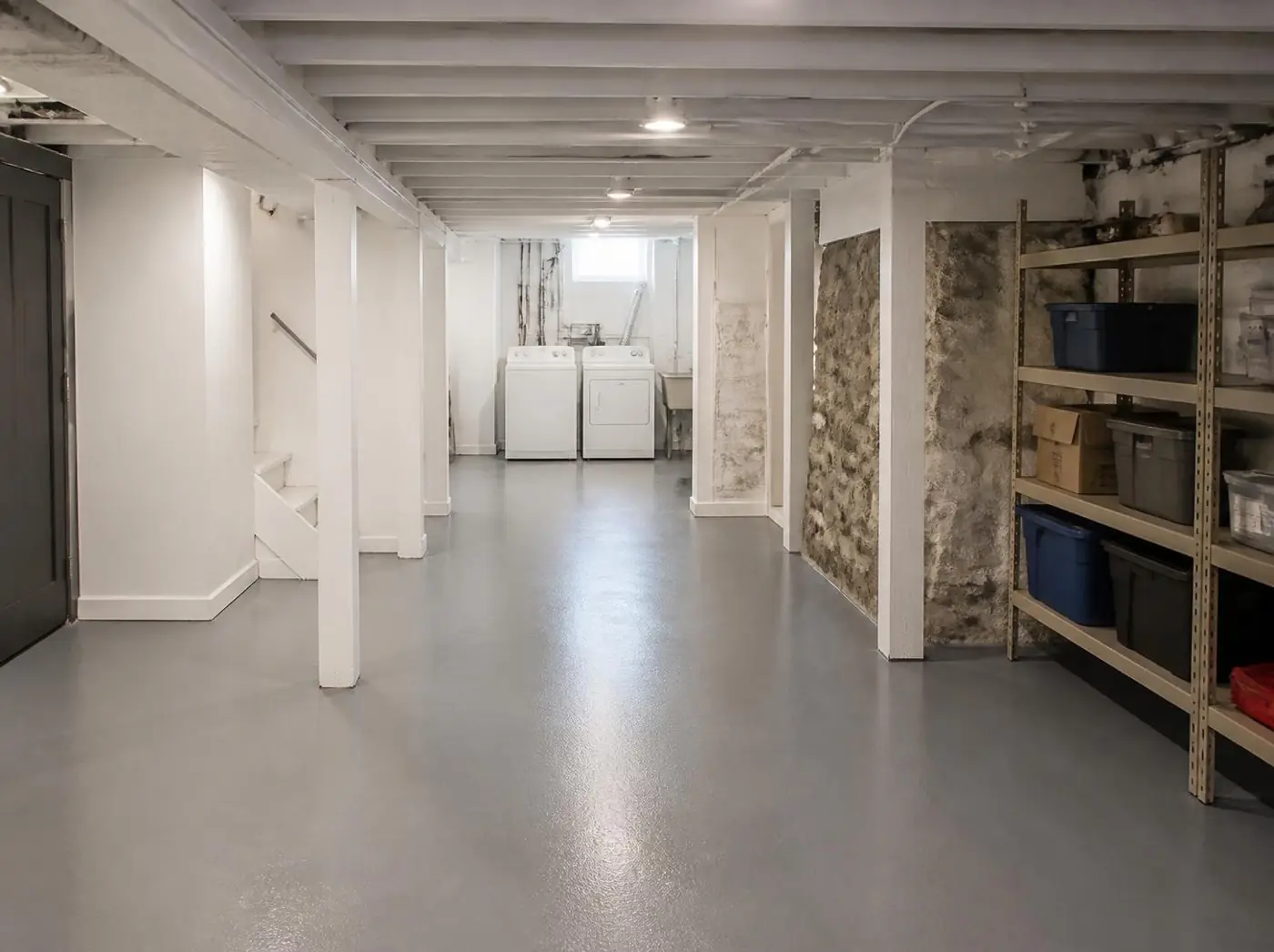
The problem with basement slabs
Basement floors are a different job from garages. The slab sits below grade, in contact with the soil, and moisture can move up through the concrete — especially in older homes. Across Greater Hartford and New Haven there are a lot of prewar and postwar homes, and many of those basements were poured without a modern vapor barrier underneath. The result is the familiar list: a dusty, gray floor that never looks clean, efflorescence (white, chalky salt deposits), musty smells, old paint that is peeling in patches, and cracks from decades of settling.
A coating can make a big difference down there, but only if it is matched to the slab. Put a standard coating over a slab that is pushing moisture and it can blister and peel. That is why every basement job starts with testing, not with a sales pitch.
Step one: moisture testing
Before we recommend any system, we check the slab for moisture. Depending on the floor, that can include a plastic sheet test, a calcium chloride test or a moisture meter reading. If the readings are low, a standard system is usually fine. If they are moderate, we may recommend a moisture-tolerant or vapor-mitigating primer under the coating. If there is active water — standing puddles, seepage at the walls or a slab that stays wet — the water problem needs to be addressed first, and we will tell you so rather than coat over it.
Want to understand the tests yourself? Read our guide to concrete moisture testing before epoxy.
Basement floor options
Solid-color epoxy
A clean, uniform color — light grays and tans are popular because they brighten a dark basement. Solid color is generally the most budget-friendly system and works well for laundry rooms, storage areas and workshops. It does show dust and imperfections more than flake.
Flake epoxy
The same full-broadcast system we use in garages. The speckled finish hides dust, dirt and small flaws, adds light texture for grip and handles workshop or gym use well. Learn more about flake epoxy floors.
Metallic epoxy
For a finished rec room, bar or home theater, metallic epoxy gives a glossy, stone-like look. It needs a dry, well-prepared slab and is the most decorative option.
Short install window? Polyaspartic topcoats cure faster and are another option, depending on the slab.
How a basement install works
- Test and plan. Moisture testing and a look at cracks, old coatings and drainage.
- Protect and prep. We protect walls, stairs and utilities, then diamond-grind the slab with dust collection. Old paint and sealers come off.
- Repair. Cracks, pits and uneven patches are filled and ground flush. See concrete repair and floor prep.
- Prime and coat. A primer suited to the slab's moisture level, then the base coat, flake or metallic layer and clear topcoat.
- Cure. Foot traffic is often possible after about a day, with furniture typically waiting longer — it depends on the product and temperature. Basements tend to stay at steadier temperatures than garages, which helps.
Our process page walks through each step in detail. Ventilation matters during install; we will talk through it for your space before we start.
Typical basement floor pricing
Basement floors typically run about $3–$9 per square foot depending on the system: solid-color epoxy around $3–$6, flake around $5–$9, and metallic higher at around $7–$12. Moisture-mitigating primers and heavy repair can add cost, with repair typically adding about $1–$3 per square foot. These are estimates — the slab decides the final number. See our cost guide or request a free quote.
Basement floors across the region
We coat basement floors in older and newer homes throughout Greater Hartford and New Haven, including Wethersfield, New Haven and Newington. See all service areas.
Frequently asked questions
Can you epoxy a basement floor that gets damp?
It depends on how much moisture is coming through the slab. Light dampness can often be handled with a moisture-tolerant primer or vapor-mitigating epoxy. Active water, standing puddles or a slab that keeps showing dark wet spots needs the water problem fixed first. That is why we test before we coat — putting a standard coating on a wet slab is a common cause of peeling.
How do you test a basement floor for moisture?
Common methods include taping a sheet of plastic to the slab and checking underneath after a day or two, and a calcium chloride test that measures how much moisture moves through the concrete. A meter can give a quick read too. Our guide to concrete moisture testing explains each method and what the results mean for a coating.
What does basement floor epoxy cost?
Basement floors typically run about $3–$9 per square foot depending on the system. A solid-color epoxy is generally at the low end, around $3–$6, while a flake system runs about $5–$9. Moisture mitigation primers or heavy repair can add cost — repair typically adds around $1–$3 per square foot. A free estimate gives you a number for your basement.
Is epoxy a good floor for a finished basement?
For many basements, yes. A coated slab is seamless, easy to clean, holds up to spills and does not mind occasional dampness the way carpet or laminate can. It can feel harder and cooler underfoot, so many homeowners add area rugs in living spaces. For a decorative look, metallic epoxy is also an option once the slab passes a moisture check.
Ready for a garage floor that cleans up in minutes?
Free on-site estimates across Greater Hartford and New Haven County.