
Flake Epoxy Garage Floors in Connecticut
A full-broadcast flake system turns a stained, dusty, salt-scarred slab into a tough, textured floor that is easy to clean — built for Connecticut winters.
Get a Free Quote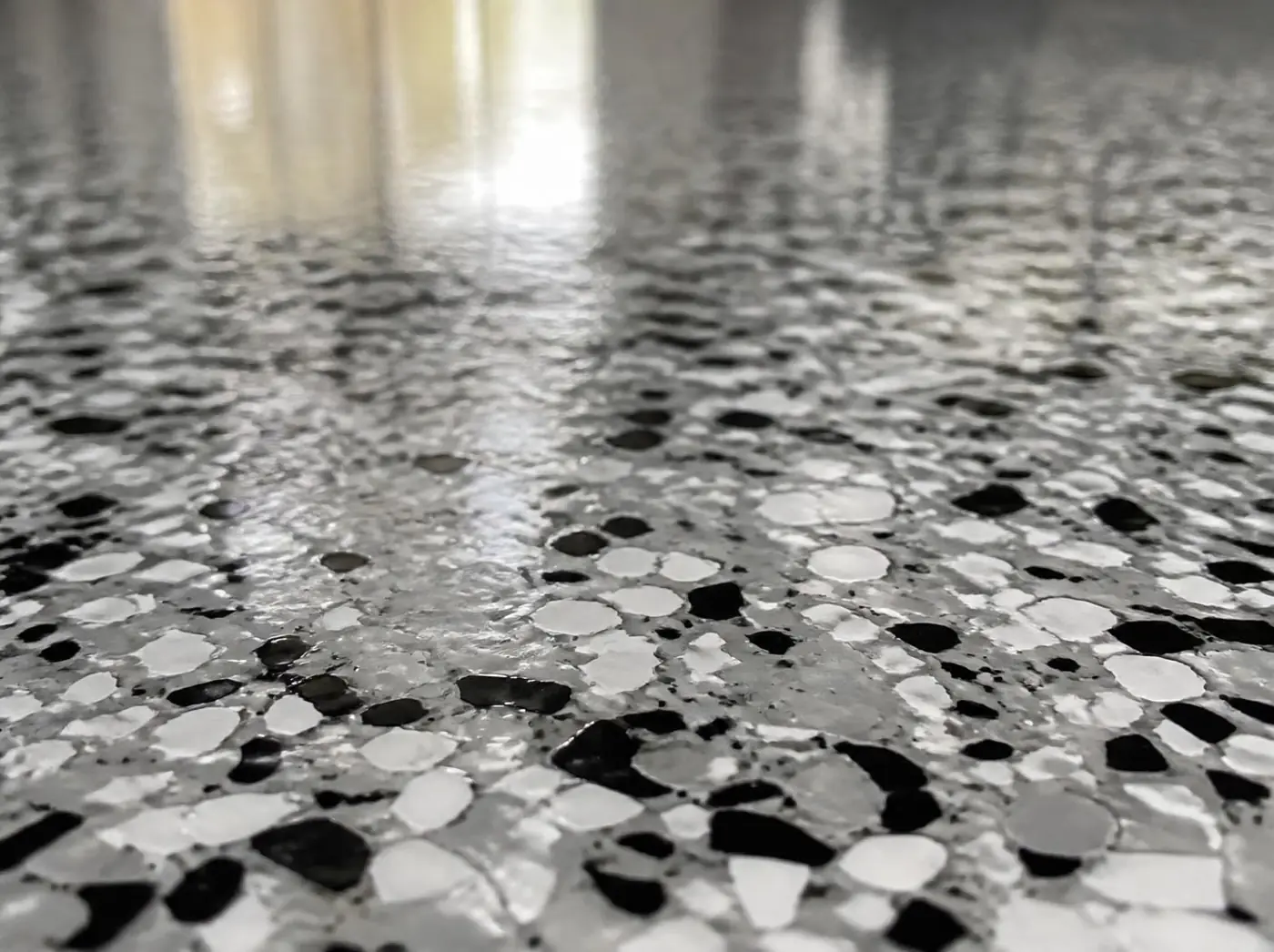
The problem with bare concrete in a Connecticut garage
Bare concrete was never meant to be a finished floor. It is porous, it sheds dust, and it soaks up everything your car drags in. In Greater Hartford and New Haven, that means a winter's worth of salt slush, liquid brine and calcium chloride dripping off the wheel wells and sitting in puddles under the car. As that salty water soaks in and goes through freeze-thaw cycles, the top of the slab can pit, scale and flake away. Add oil drips, tire marks and the gray dust that tracks into the house, and most garage floors look tired within a few years.
Paint and thin DIY kits rarely solve this. They sit on top of a poorly prepared surface, then lift under hot tires or peel once moisture and salt get underneath. If you want a floor that holds up season after season, the coating has to be part of a full system — and the prep has to be done right.
What a full-broadcast flake epoxy floor is
A flake floor (also called a chip or broadcast floor) is a multi-layer coating. A pigmented base coat goes down on a ground, repaired slab, and while it is still wet we broadcast decorative vinyl flakes across the entire floor until no base color shows through. That is what “full broadcast” means. Once it sets, the loose flakes are scraped and vacuumed off and the floor is sealed with a clear topcoat that locks the chips in.
The result is a floor with real thickness, a slight texture you can feel underfoot, and a speckled finish that is far more forgiving than a solid color.
Why flake suits Connecticut garages
- Salt and brine stay on top. A sealed topcoat keeps salty meltwater from soaking into the concrete, so you can squeegee it out the door instead of watching it eat the slab.
- Texture for grip. The broadcast chips give the surface a light texture that is generally less slick than smooth, glossy epoxy — helpful on wet winter days.
- Hides dust and dirt. The multi-color speckle hides dust, sand, salt residue and small scuffs between cleanings much better than a solid color.
- Covers imperfections. Repaired cracks, patched spalls and minor surface variation all disappear under the flake.
- Easy to clean. A sealed floor sweeps, mops and hoses off without the dust that bare concrete constantly sheds.
How we build a flake floor, layer by layer
Every flake floor follows the same basic build. The products and timing can change with the season and the slab, but the steps do not.
- Diamond grind. We grind the whole slab with diamond tooling and vacuum the dust. Grinding opens the pores and removes weak surface concrete so the coating can bond, rather than just sitting on top. See our concrete repair and floor prep page for why we grind instead of acid etching.
- Repair. Cracks, pitting, salt scaling and spalled areas are filled and ground flush so they do not telegraph through the finish.
- Base coat. A pigmented base coat is rolled out evenly. Its color is chosen to blend with the flake blend you pick.
- Flake broadcast. While the base is wet, we broadcast flake to full rejection — the floor is covered until it cannot take any more chips.
- Scrape and clear topcoat. Once set, loose flake is scraped and vacuumed, and one or more clear topcoats seal the floor. On many jobs that topcoat is a UV-stable polyaspartic, which resists yellowing near a sunny garage door.
For a full walk-through of install day, cure times and when you can park again, see our process.
Color and flake options
Flake blends come in a wide range of colors and chip sizes. Most homeowners choose a blend of grays, tans or blacks with a few accent colors, because neutral blends hide dirt and salt residue best. Larger chips give a bolder, more granite-like look; smaller chips read as a finer speckle. Base coat color is usually matched to the dominant tone in the blend so any tiny gaps disappear. We bring samples to the estimate so you can see them in your own garage light.
Prefer a sleek, high-gloss showroom look instead? Take a look at metallic epoxy floors. Need a floor for a below-grade room? Start with basement floor epoxy.
What a flake floor typically costs
As a typical range, a full-broadcast flake epoxy floor runs about $5–$9 per square foot installed. For a typical two-car garage of 400–480 square feet, that often works out to roughly $2,500–$4,800, depending on the system and the condition of the slab. Heavy crack and spall repair or removing an old coating can add around $1–$3 per square foot. These are estimates — your price depends on your floor. Our garage floor epoxy cost guide breaks it down in more detail.
Flake floors across Greater Hartford and New Haven
We install flake systems in attached and detached garages throughout the region, from older detached garages in Hartford to attached two- and three-car garages in Glastonbury and inner-ring homes in Hamden. See all of our service areas.
Frequently asked questions
How much does a flake epoxy garage floor cost in Connecticut?
A full-broadcast flake epoxy system typically runs about $5–$9 per square foot installed in Greater Hartford and New Haven. A typical two-car garage of 400–480 square feet often lands around $2,500–$4,800 depending on the system and slab condition. Cracks, spalling or old coatings that need removal can add roughly $1–$3 per square foot. We give a firm number after seeing the floor.
Is a flake floor slippery when it is wet?
A full-broadcast flake floor has a light texture from the chips under the clear topcoat, so it generally offers more grip than a smooth, glossy epoxy. It can still get slick with snowmelt, oil or ice on top. If traction matters, we can add an anti-slip additive to the topcoat to give the surface more bite without making it hard to mop.
Will road salt damage a flake epoxy floor?
A properly installed flake system with a sealed clear topcoat keeps salt brine on the surface instead of letting it soak into the concrete, which is the main way salt damages bare slabs. Salt can still dull the finish or leave a film over time, so rinsing or mopping the floor a few times over the winter helps keep it looking good.
Can you put flake epoxy over an old, stained garage floor?
Usually, yes. Oil stains, tire marks and old paint are ground off or reduced during diamond grinding, and the flake broadcast hides minor staining that remains. Heavy oil saturation, peeling coatings or moisture problems need extra prep and sometimes extra cost. We check the slab during the free estimate and tell you plainly whether it is a good candidate.
Ready for a garage floor that cleans up in minutes?
Free on-site estimates across Greater Hartford and New Haven County.